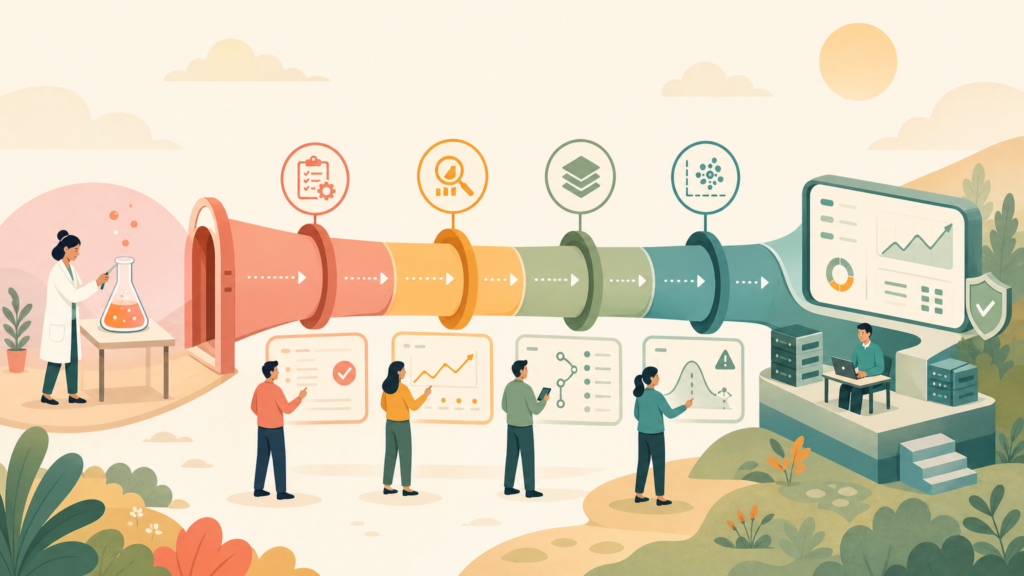
There’s a report that came out last week that really should be read by everyone involved in the manufacturing industry in Sweden. Fictiv and MISUMI have done their eleventh annual survey of the industry – 300+ leaders at director level and above, in everything from EV to medtech to robotics. And the numbers are pretty clear about where the industry is right now.
AI adoption in manufacturing jumped from 87% to 93% in a single year.
(Source: BitcoinEthereumNews.com)
It is not a trend anymore. It is a new baseline.
What “embedded” actually means
97% of leaders surveyed say AI is already embedded in core production and supply chain processes, and 95% see AI as a requirement rather than an option.
(Source: The Robot Report)
It’s an interesting formulation – “requirements rather than alternatives.” A couple of years ago, the same industry talked about AI as an experiment. Now it’s a hygiene factor.
But the real question is not whether you use AI. It’s what you do with it.
The report points to a concrete bottleneck problem that is quite telling:
83% of engineers spend four hours or more per week on purchasing-related workflows
– administrative work that in theory is perfect for automation.
93% of managers say that productivity improves when administrative tasks are removed.
(Source: The Robot Report)
Everyone knows that. Yet it is not happening fast enough. It is that gap that is interesting. Not whether AI works – but why implementation is still moving in steps.
Infrastructure is the bottleneck, not the will
My view, and it’s quite consistent with what we see from customers, is that the problem is rarely ambition. It is infrastructure and data control.
Setting up an AI system for predictive maintenance on a production line is not complicated in theory. But it does require that the sensor data is actually available, structured, and in an environment where you can run models against it. It requires that you own your data properly – not have it scattered in three different cloud provider silos with unclear terms.
The manufacturing industry generally has mature OT environments and rigorous reliability requirements. These are strengths. But it also means you can’t just ‘point to the cloud’ and hope it works. You need to think about where the calculations take place, who owns the models and how to ensure that the systems actually deliver in production-critical environments.
What it means for Swedish manufacturers
Sweden has a strong manufacturing sector – Volvo, SKF, Sandvik, Atlas Copco, and a broad ecosystem of subcontractors. That kind of industrial heft is an asset in the AI transformation, but only if you start with the right foundation.
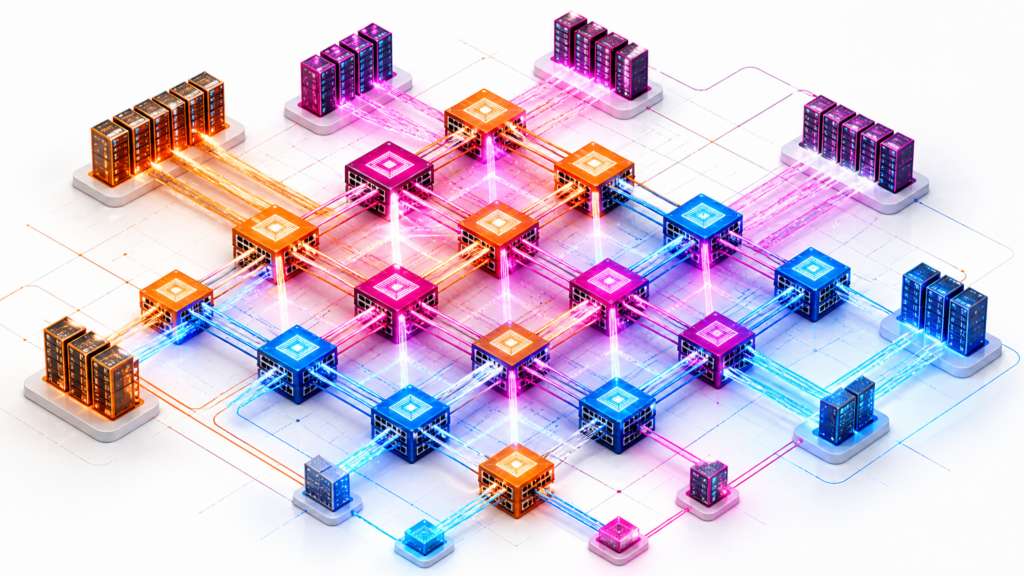
In concrete terms, this means: GPU capacity to train and run your own models, MLOps infrastructure that provides reproducibility and control, and computing environments that can actually handle production data safely.
It’s not a conversation about “which AI model should we use?” It’s a conversation about architecture.
We have those conversations with customers in this industry. If you’re heading into them – get in touch.
—-
Full report from Fictiv and MISUMI
Petter Ahlén
Sales and Marketing Manager, Aixia AB