CNBC published an article yesterday(May 18) with an uncomfortable headline: “High energy prices could derail Europe’s AI race with U.S. and China”. It’s basically about geopolitics and investment flows – but if you’re an IT or infrastructure manager, the conclusion is more concrete than that. The electricity that powers your AI workloads has become a strategic issue, not just a bottom-line operational cost.
The figures are clear. According to the IEA, European energy-intensive industries pay, on average, twice as much for their electricity as industries in the US, and 50% more than in China. For those planning to scale up AI, this means that two issues that used to be the domain of real estate and procurement – where to put the computing power and what it costs to run – now belong in the AI strategy.
What it means for you to go from pilot to production
Most of the organizations we talk to have already moved beyond the experimental stage. The models work, the benefits are proven on a small scale, and the next step is production. This is when the physical reality kicks in.
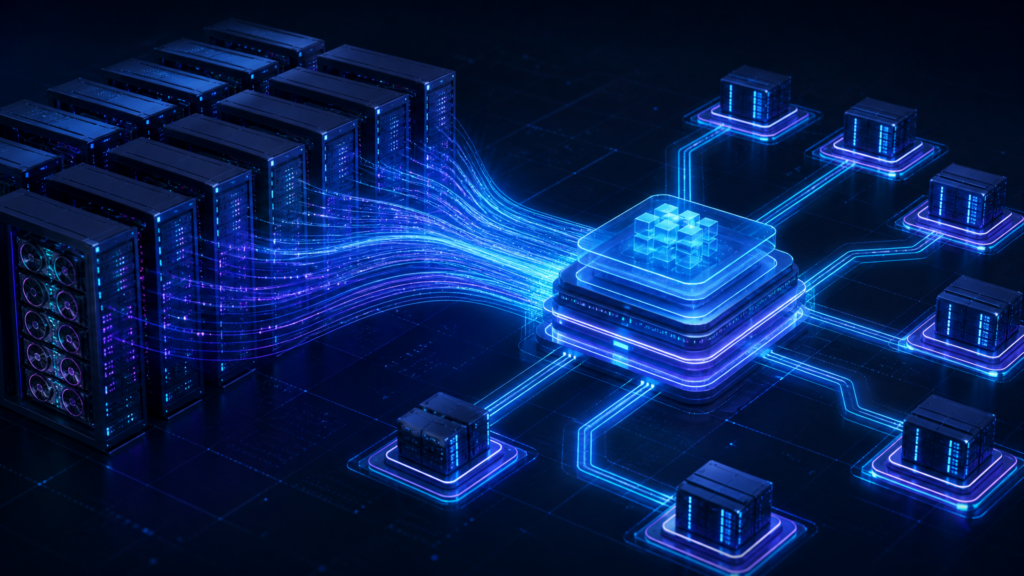
There is a shift underway that is easy to underestimate. A typical server rack used to draw around 7-10 kW. The AI clusters we deploy today, built on NVIDIA’s Blackwell architecture, are 40 kW and up – in the heaviest cases 130-150 kW per rack. At those power levels, air cooling is not enough, and the power supply needs to be sized and stable in a way that a traditional data center rarely is.
In practice, there are three issues that determine whether the AI venture will be profitable:
- Where the computing power should stand. Electricity and cooling conditions differ greatly between regions. The wrong location can make a fundamentally sound AI investment unprofitable.
- What it actually costs over time. The price of the hardware itself is often the smaller part. It’s the electricity, cooling and utilization rates that determine the true total cost – and far too few people calculate that before making a decision.
- If you keep control over data and capacity. Putting the AI workloads in an overseas data center solves the capacity issue in the short term, but at the same time shifts control over where the data is located and how quickly you can reconfigure.
The Nordics have a head start – and we can use it to your advantage
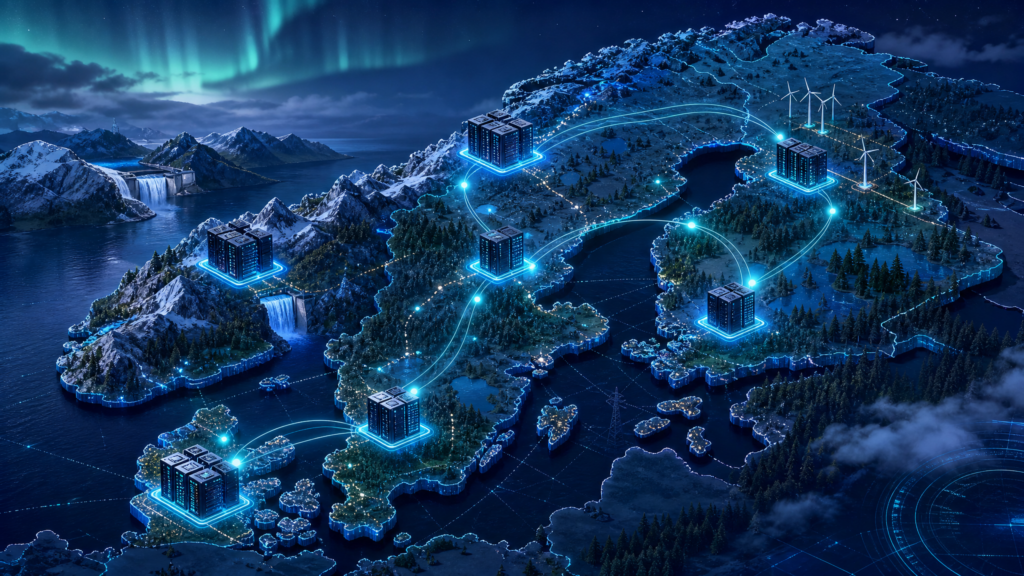
CNBC describes how data center operators are leaving the congested hubs of central Europe – the FLAP-D cluster: Frankfurt, London, Amsterdam, Paris and Dublin – and looking outwards instead. This benefits the Nordics: cool climate, fossil-free electricity and high technical expertise.
For you as a customer, this is worth something concrete. It means you can build large-scale AI capacity on Swedish soil, with fossil-free operation and a competitive energy profile, without compromising on the location of your data. But the article also comes with a warning that we take seriously: even the Nordic electricity grids are becoming fully utilized, and grid connection lead times can become a bottleneck. This makes when and where you plan your capacity an issue worth tackling early – not when the hardware is already on the loading dock.
How we help you at Aixia
For us, this is not a future issue. It’s what we do every day. As the only NVIDIA DGX SuperPOD certified partner in the Nordics, we build AI infrastructure where electricity, cooling and computing power are connected from the very first drawing. Specifically, we can help you to:
- Calculate the real cost. We do a TCO analysis that takes into account electricity, cooling, utilization and lifetime – not just the list price of the hardware – so that the decision is based on the right numbers.
- Choosing the right location and mode of operation. On-prem, colocation or a combination – we help you weigh capacity, data sovereignty and cost against each other based on your business, not on a ready-made standard solution.
- Design for today’s power levels. We design for 40-150 kW per rack with liquid cooling, high power density, fossil-free operation and waste heat recovery – so the infrastructure will last for the next generation of models.
- Take the step all the way to production. With our MLOps platform AiQu, we take you from individual pilot projects to large-scale operation – on an infrastructure you control.
The point is simple: it should be the business benefit that determines your AI investment – not that someone missed counting the electricity.
Next steps
If you are about to scale up AI from pilot to production – or you suspect that the infrastructure you have today is not built for what’s coming – then it’s the right time to do the math.
Contact us at Aixia for an unbiased review. Together we will go through your planned AI workloads, make an initial assessment of capacity and energy needs and give you a clear picture of cost, location and schedule – before investment decisions are locked. It’s a small effort that can make a big difference to your bottom line later on.
- 📞 Phone: +46 (0) 31 762 02 40
- ✉️ E-mail: info@aixia.se
- 🌐 Web request: Contact Aixia
Source: CNBC, “High energy prices could derail Europe’s AI race with U.S. and China”, May 18, 2026.