Ask an AI assistant this question: “Which vendors should I talk to about this?”
You rarely get ten blue links in return. You get three names and a brief explanation of why those specific ones.
And if your company isn’t one of those three names, you’ll never know you were even in the running. There’s no missed click in the statistics. No visitor who bounced after ten seconds. You just weren’t part of the answer, and no one sent an email about it.
It was that realization that prompted us to start working on this in earnest. We decided fairly early on to test it out on ourselves first. It felt strange to sell something we hadn’t actually put into production ourselves.
SEO stands for Search Engine Optimization
Search engine optimization in Swedish. The art of ranking high on a list of search results. This has been the game for about twenty years, and most people have some kind of connection to it—even if that connection mostly consists of emails from agencies promising the top spot on Google.
AEO stands for Answer Engine Optimization
In other words, answer engine optimization. This isn’t about ranking on a list. It’s about becoming part of the actual answer that an AI assistant formulates. Some call it GEO, or Generative Engine Optimization. The names are still up for debate, but the principle is the same.
The difference may seem small, but it isn’t. In SEO, you’re competing for a ranking. In AEO, you’re competing to be mentioned in a text that someone else writes for you, worded slightly differently each time.
And this isn’t just a matter for the future
Arfadia’s data from early 2026 shows that 68 percent of all Google searches now end without anyone clicking through. AI-generated summaries appear in over 20 percent of searches, and when they appear, the click-through rate drops by nearly 60 percent. Similarweb
In other words, about two out of every three searches end before reaching anyone’s website.
Why It Suddenly Became Difficult to Measure
With traditional SEO, you could check your ranking for a keyword. Fourth on Tuesday, sixth on Friday—someone wrote a report about it.
That measurement no longer exists in the same form.
An AI response varies depending on how the question is phrased, which model is responding, what time of day it is, and sometimes who is asking. There is no “position 3” to monitor. The only way to know how visible you are is to actually ask the questions, over and over again, and count how often your name comes up.
Which is exactly the kind of work no one can bear to do every week for more than a month.
But it’s a great job for an agent.
What an AI agent actually is
A chatbot responds when you ask a question. An agent is working.
The difference is that the agent is given a goal, access to tools, and the ability to take several steps in sequence on its own. It can gather information, compare it, draw a conclusion, take action, and come back with a proposal.
Kind of like an intern who never sleeps, never gets bored of repetitive tasks, and always documents what they’ve done. With the same need for a boss who says yes or no.
What Our Agents Do, in Practice
We’ve deliberately kept it small. Five tasks, not fifty.
1. They ask the questions that customers ask. The agent has a list of real questions that people in our industry actually ask—not the search terms we wish they would use. The list is regularly run through several different models.
2. They count who is mentioned. Every response is logged. Were we mentioned? Was a competitor mentioned? Which source was cited? Over time, this becomes a trend rather than a gut feeling—and gut feelings are notoriously bad at remembering what things looked like back in February.
3. They look for openings. What’s interesting isn’t the topics everyone is already writing about. It’s the questions where the answers are superficial, outdated, or completely lacking a local perspective.
4. They produce drafts, not finished texts. The agent provides a brief: what the topic is, who it’s for, what’s missing from the current response, and what questions the text must answer. Then a person writes it. We’ve never been tempted to eliminate that step.
5. They take care of the boring stuff. Broken links, outdated information, headlines that don’t say anything, pages that say different things about the same topic. Undramatic work that no one has time for—but which turns out to play a surprisingly important role.
Here’s what a proposal from the agent looks like
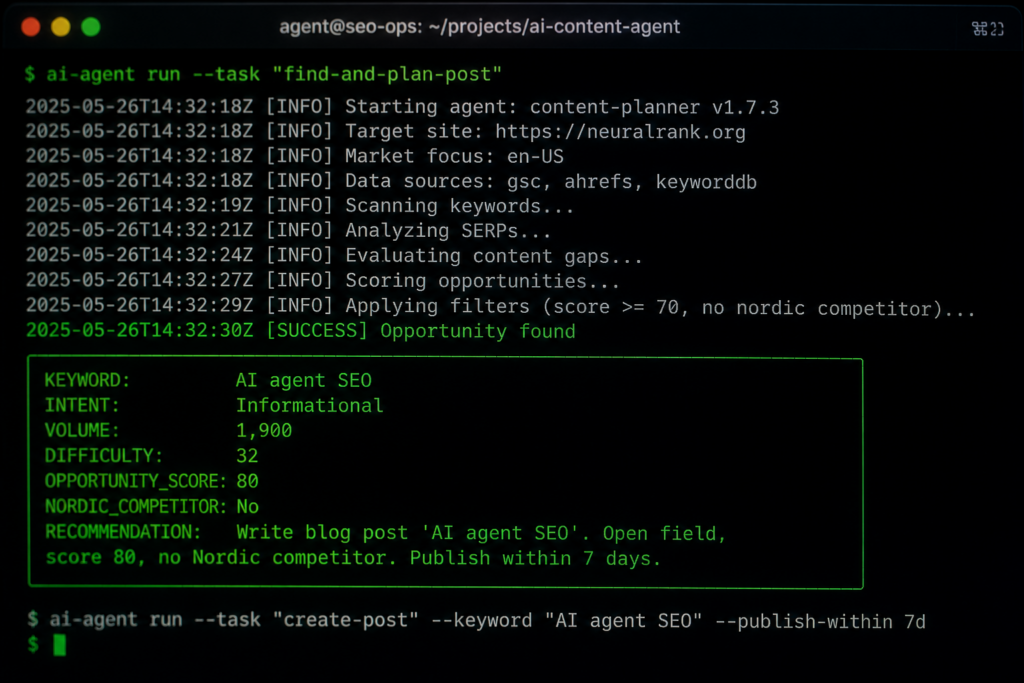
A rough note from our own agent looked something like this:
Write a blog post titled “AI Agent SEO.” Open field, score 80, no Nordic competitors. Publish within 7 days.
Concise. And pretty incomprehensible unless you work with it every day. Here’s what the same thing looks like when translated into something a person can use to make a decision:
“Open field” means that when the agent asked questions on this topic, the answers were vague and based almost exclusively on American sources. No one had taken ownership of the issue locally.
“Score 80” is the agent’s own priority rating on a 100-point scale. It’s a weighted average of how often the question is asked, how weak today’s answers are, and how well the topic aligns with what we actually know. The last factor is more important than it sounds. It’s perfectly possible to rank things you don’t master, and that’s rarely a good idea.
“No Nordic competitor” means that no one in the region has written anything substantial on the subject. The field was empty.
“Publish within 7 days” isn’t just stress for the sake of it. Open fields close, and they do so quickly. Citation patterns in AI responses can shift dramatically in just a few weeks. There’s no position to fall back on—only a position you hold for as long as you can hold it.
The text you’re reading right now is the result of that very suggestion. The agent found the gap and explained why it was worth filling. Someone agreed and wrote it.
One more thing worth knowing
Your own website isn’t the whole picture. Analyses of citation patterns suggest that your own content accounts for about a quarter of what determines whether you’ll be cited. The rest is built elsewhere. It’s uncomfortable to hear this if you’ve just allocated a budget to your own site, but it’s better to know it in advance. Wellows
People decide, every time
This is the most important design principle in everything we’ve built. The agent makes suggestions; the human approves them.
Nothing is published automatically. Nothing is sent out without someone reading it first.
The risk with bots isn’t that they make mistakes. People do that, too—often and readily. The risk is that they make mistakes at high speed and in large volumes. A person who writes a bad text writes a bad text. A bot with no restraints produces fifty, publishes them, and links them to one another.
The approval step is therefore not a hindrance. It is precisely what gives you the confidence to let the agent take on more.
Where the models are run matters
Take a moment to think about what is actually entered into a system like this.
What questions your customers are asking. What gaps you see in the market. What your priorities are. What you plan to publish next. How you assess your competitors.
To be honest, it’s a fairly comprehensive picture of a business strategy.
That is why we run our models exclusively on our own infrastructure, in Swedish data centers, on hardware owned by Aixia. We are a wholly Swedish company. No data leaves our environment, nothing is used to train anyone else’s model, and there is no user agreement that can be rewritten overnight by someone on the other side of the Atlantic.
That’s not just an argument on our behalf. It applies to anyone considering bringing AI into their business. Ask where the model is running. Who owns the hardware. What happens to the data you feed into it. Under which laws does all of this fall? And ask who’s in charge of operations when something breaks at 6:30 p.m. on a Friday night.
If the answers are vague, that’s an answer too.
Four Things We’ve Learned Along the Way
Start small. One agent who does one thing well is better than five agents who do everything half-heartedly. We started with two, and even that was one too many.
The agent is good at handling volume but lacks good judgment. It sees patterns that no human has time to notice. It doesn’t know what is true, important, or appropriate to write. It’s the combination that matters, not the agent itself.
Measure before you start production. It’s tempting to just jump right in and start writing, because it feels productive. Without a baseline, you’ll never know if anything actually changed or if it just felt that way.
What works for AI works for people. Clear answers, concrete examples, personal experience, up-to-date information. We haven’t found any shortcut that allows us to cut corners without compromising the reader’s experience. We’ve looked.
The same pattern applies far beyond the realm of marketing
Nothing in this is really specific to online visibility.
The basic pattern is always the same. A repetitive task that no one has time for. A clear scope. Access to the right information. And someone who gives approval before anything actually happens.
The same reasoning applies when building AI support into production—an assistant that searches your own document archive, or any other scenario where the system is expected to do more than just answer questions. We’ve written before about why that particular aspect is more difficult than it sounds.
We built this for ourselves first. Now we’re building similar solutions for customers, in their environments and using their data, based on AiQu.
If you’re curious about where in your business an agent would be most helpful, it’s usually a brief and fairly concrete discussion. Feel free to reach out.
AI Infrastructure | AI for Industrial Companies | IT Operations | AI Solutions