Network security is not a product; it is an architecture
Blog | Aixia
Firewalls and antivirus software aren’t enough. Security must be an integrated part of the architecture—from network design to identity management and monitoring.
Most companies today have a firewall. Many even have a very good one from a leading vendor. But far fewer have a well-thought-out strategy for how the firewall interacts with the rest of the infrastructure.
As NIS2 and the Swedish Cybersecurity Act tighten requirements for governance, risk management, and incident reporting, we see a clear pattern: many hope that purchasing a new security product will solve the problem. But the truth is that even the most advanced security solution loses its effectiveness if it is deployed in a weak or fragmented architecture.
As a natural follow-up to our previous post on NIS2, we’d like to take a closer look at why security shouldn’t be viewed as something you buy piecemeal, but rather as something you build into the network’s structure from the very beginning.
The Difference Between Reacting and Acting
A reactive security model is often based on the idea of a strong outer shell. The assumption is that the firewall at the network’s perimeter will stop external threats. But in practice, many breaches occur in other ways—for example, through stolen identities, misconfigured services, or vulnerable IoT devices. Once an attacker has gained access, it is often the freedom of movement within the network that determines the extent of the damage.
Instead, a more proactive security architecture is based on principles such as Zero Trust, segmentation, and high visibility into traffic. The starting point is not that everything inside the perimeter is trusted, but that every user, device, and communication must be assessed based on context and policy. It’s not just about stopping intrusions, but about limiting the consequences when something does go wrong.
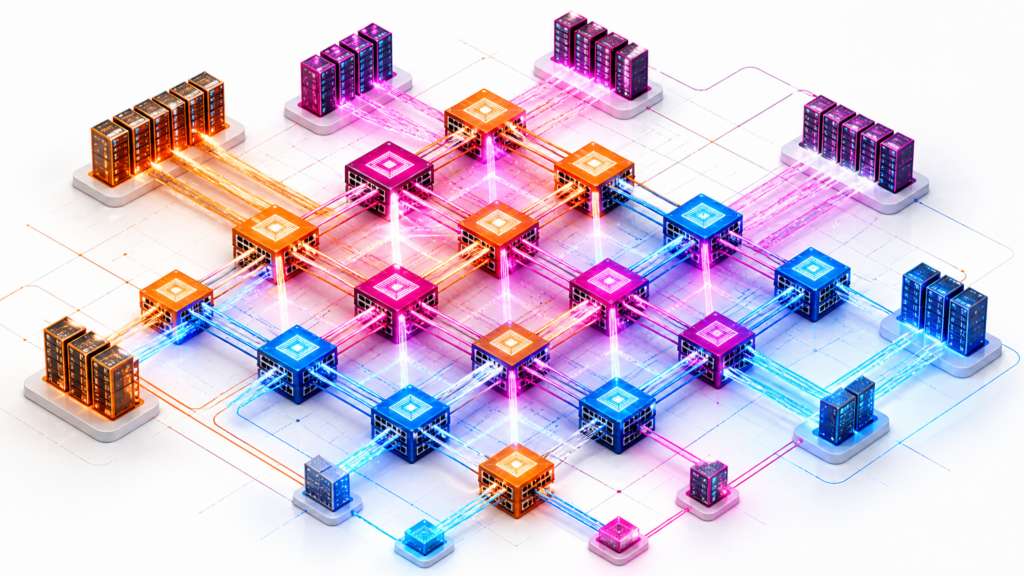
In practice, this means building a network in which different parts of the environment are clearly delineated, where traffic can be analyzed in greater detail, and where anomalies can be detected in a timely manner. It’s the difference between simply locking the front door and actually having control over the entire building.
When Architecture Makes a Difference
Imagine that a regular workstation is infected with ransomware. In a traditional environment, malware can quickly spread to servers, storage systems, or other critical systems if the network lacks clear segmentation and control over internal traffic.
In a more modern architecture, networking and security features can work together to limit the spread. With the right combination of segmentation, traffic control, and policy-based security, it is possible to build an environment where traffic can be routed for inspection, different parts of the network can be more clearly separated, and risks can be managed with greater granularity than in a traditional model.
This reduces the risk that a breach in one part of the network will immediately become a business-critical problem across the entire environment.
Why We Often Recommend Arista and Palo Alto Networks
The reason we at Aixia often recommend Arista and Palo Alto Networks together is that this combination offers excellent opportunities to build networks that are more secure right from the design stage.
Instead of trying to solve everything through a single central control point, you can build an architecture where security policies and traffic inspection are placed where they are most effective. This can provide better control over traffic flows, clearer segmentation, and better conditions for detecting anomalies even within the network, not just at the edge of the Internet.
This is also relevant in light of NIS2. The regulatory framework is not just about having security products in place, but about being able to work in a structured manner with risk management, accountability, governance, and incident reporting. In this context, visibility, segmentation, and documented controls become central components of the overall approach.
Security as an Integrated Service
We know that reviewing your entire network architecture can feel like a daunting task, especially as cybersecurity requirements continue to grow. That’s why we at Aixia help our customers build networks and security solutions that work together in practice—not just on paper.
It’s about ensuring the architecture works as a cohesive whole: that firewalls, switches, policies, segmentation, and operations work together, and that you have the visibility and control needed to make the right decisions, manage risks, and be better prepared when incidents occur.
Ultimately, network security isn’t about which logo is on the box in the server room. It’s about how well the entire environment is designed to withstand, detect, and mitigate attacks.
Are you ready to move from individual products to a more sustainable security architecture? Contact us for an overview of how we can help you build an environment that strengthens both security and operational resilience.
🔧 Here’s how Aixia can help you
At Aixia, we have deep expertise in network security. We help you turn your strategy into reality.
Published by Aixia | 2026