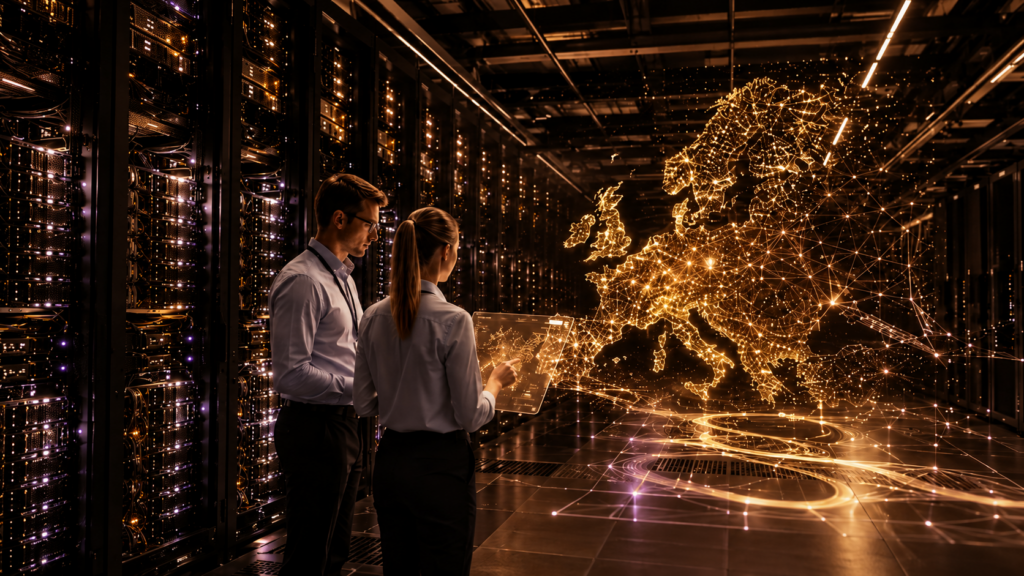
Can Europe compete with China’s supercomputers?
China’s LineShine tops the TOP500 with 2.198 exaflops—a pure CPU architecture that sends a clear geopolitical signal. But raw HPL performance doesn’t tell the whole story when it comes to AI dominance. Here’s a look at Europe’s response.
TL;DR — Summary in three points
China’s LineShine dominates the TOP500 with 2.198 exaflops, but as a pure CPU architecture, it isn’t automatically the best for AI. Europe has JUPITER (exascale), LUMI, and the upcoming Arrhenius. For Nordic companies, the key is not to compete with national supercomputers—it’s to deploy the right computing power in the right place.
China’s new supercomputer, LineShine, has secured the top spot on the TOP500 list with a measured HPL performance of 2.198 exaflops. Reaching over two exaflops—that is, more than two trillion floating-point operations per second—represents a level of computing power that dwarfs traditional national research programs. However, LineShine is about more than just raw speed; the machine sends a clear geopolitical signal.
The system is installed at the National Supercomputing Center in Shenzhen and is built entirely on China’s own LingKun platform: Arm-based LX2 processors with 304 cores per chip, the proprietary LingQi network, and the Kylin operating system. In total, this amounts to nearly 13.8 million cores. LineShine thus becomes the first supercomputer on the list to break the two-exaflops barrier in sustained double-precision performance using only CPUs.
This poses a critical question for Europe: How should we compete now that supercomputers have evolved from research tools into strategic infrastructure?
1. LineShine is fast, but the figure needs to be put into context
With its latest HPL results, LineShine has edged out the previous leader, the American El Capitan (built on the AMD MI300A), by just over 21 percent. It’s a technical feat, but the number doesn’t tell the whole story.
The TOP500 list primarily measures traditional HPC performance—the kind of double-precision floating-point calculations that power climate models, materials research, and advanced physical simulations. The modern AI landscape, however, requires entirely different characteristics:
- Low precision
- Massive memory bandwidth
- Lightning-fast communication between accelerators for training large models
Analysts therefore emphasize that LineShine isn’t automatically the world’s best AI machine just because it tops the list. A pure CPU architecture can be fantastic for heavy scientific simulations, but less optimal for modern AI training compared to GPU-intensive systems. What makes LineShine interesting is that China has chosen not only to copy the West’s focus on GPUs—it has built its own, alternative architecture.
2. Why is China building its own processors?
The obvious driving force is the U.S. export restrictions that have for several years curtailed China’s access to advanced HPC and AI chips from Nvidia and AMD. But beneath the surface, it’s all about sovereignty.
As computing power becomes the driving force behind everything from defense and energy supply to biotechnology and AI, supercomputers can no longer be viewed as ordinary IT purchases. They are national assets worthy of protection, on the same level as the power grid or transportation infrastructure. China simply wants to eliminate all dependence on foreign chips, networks, and operating systems. LineShine is therefore as much a geopolitical statement as it is a technical achievement.
3. Europe Is Not Without Hope
The perception of a Europe that has fallen behind the U.S. and China is widespread, but it’s too black-and-white. We’ve already come a long way.
JUPITER in Germany, operated by the Jülich Supercomputing Center as part of EuroHPC, is the continent’s first true exascale system. With its modular architecture—divided into a GPU-accelerated booster section and a general-purpose cluster section—it is built to handle both traditional research and heavy AI workloads.
At the same time, the Finnish company LUMI in Kajaani delivers approximately 380 petaflops of sustained performance. The system is also a key resource for Sweden, as we are part of the consortium and Swedish researchers have direct access to the resources. On-premise, we also have a solid foundation with NSC in Linköping (Tetralith, Berzelius) and PDC at KTH (Dardel).
The next big step is Arrhenius, which is being installed in Linköping under the NAISS banner:
- Processor capacity: 424 AMD Turin processors
- Graphics Power: 382 GPU nodes with a total of over 1,500 Nvidia GH200 Grace Hopper Superchips
- Security & Storage: Dedicated partition for sensitive data and 29 PB of high-speed parallel storage
The GPU performance comes in at 66.8 petaflops HPL —which is about seven times more than what Dardel currently delivers. This is a significant boost in raw computing power for Swedish industry and academia.
4. However, the Nordic region still lacks its own exascale capacity
Although JUPITER and LUMI are important milestones, they do not address all Nordic needs. For Swedish companies developing AI, digital twins, or autonomous systems, it’s rarely enough that “there’s a supercomputer somewhere in Europe.” The practical challenges are more about accessibility, lead times, and regulatory compliance:
- Is it possible to run business-critical data there?
- How are intellectual property rights, confidentiality, and regulatory requirements handled?
- Can environmental considerations be seamlessly integrated into our own development workflows?
- Is it possible to scale up from the experimental stage to production without getting bogged down in lengthy academic application processes?
This is where the gap between public research infrastructure and industry-oriented AI environments becomes apparent. University supercomputer centers do a fantastic job for academia, but commercial projects often require shorter lead times, strict SLAs, and total control over the environment. That doesn’t mean every company has to build its own exascale systems, but it does require a well-thought-out HPC strategy.
5. HPC is no longer just for researchers
HPC has evolved from being a concern solely for universities and industry giants to becoming a core requirement for broader business operations, driven by advancements in AI.
- Automotive manufacturers need to simulate sensor data and test autonomous functions on a large scale.
- Life science companies need to model molecules to accelerate drug development.
- The manufacturing industry is optimizing production and building digital twins.
- Energy companies simulate power grids and weather data to predict market trends.
As AI models grow, the difference between having immediate access to computing resources and having to wait in line is becoming a critical business factor. Having computing power close to the business enables faster iteration, better data protection, and a shorter path to production.
6. Mimer and AI Factories are a step in the right direction
The EU’s initiative on AI Factories is clear evidence that the seriousness of the situation has been recognized. The idea is to provide startups, companies, and the public sector with access to AI-optimized supercomputers and expert support.
Mimer AI Factory is now being established in Sweden Mimer AI Factory is being established in Linköping, with a focus on areas such as life sciences, materials science, and autonomous systems. EuroHPC has also signed an agreement for a brand-new AI supercomputer for Mimer, which is scheduled to be installed in 2026.
This is a major and welcome step, but it does not meet all needs. Large-scale public initiatives are excellent resources, but many companies require fully dedicated, isolated environments where security, performance, and day-to-day operations are fully aligned with their own organization. It is in this segment that enterprise-grade GPU clusters serve their purpose.
7. Here’s How Swedish Companies Can Gain HPC Capacity Without Building Their Own LineShine
You don’t need to match China’s millions of cores to stay at the forefront. For most Swedish companies, it’s more a matter of building a smart, customized GPU cluster with the right balance between storage, networking, and orchestration. This could be an inference cluster for AI agents, a secure environment for sensitive data, or a hybrid model where you offload heavy workloads to national resources while keeping the core in-house.
The key is to flip the process: start with the workload instead of the hardware.
By first defining which models will be trained, how much data will be transferred, and what the requirements are for confidentiality and response times, the design of the infrastructure becomes both more precise and cost-effective.
Aixia’s Perspective
At Aixia, we build AI and HPC infrastructure for Nordic companies that want to maximize their performance without losing control over their data, costs, or operations.
As the only DGX SuperPOD-certified partner in the Nordic region, we design, install, and operate GPU clusters tailored for generative AI, inference, and high-performance computing environments. This includes everything from customized on-premises solutions and private AI clouds to hybrid environments that complement major national resources.
It’s not a matter of choosing one or the other. Europe needs major flagship projects like JUPITER, LUMI, Arrhenius, and Mimer, but Nordic companies also need flexible, secure, and business-oriented alternatives. LineShine is clear proof that computing power has become a matter of hard geopolitics. However, the answer isn’t just to build the largest machines, but to create an accessible ecosystem where the right computing power is available in the right place.
Because, in the end, what matters most isn’t who owns the fastest supercomputer on the list—it’s where the innovation is actually taking place.
Frequently Asked Questions
How fast is China’s LineShine?
LineShine delivers 2.198 exaflops of HPL performance, topping the June 2026 TOP500 list.
Is LineShine the best in the world at AI?
Not necessarily. It excels at traditional HPC performance (double precision), but since it is entirely CPU-based, it is not automatically optimal for the types of low-precision computations required by modern AI training.
Does Europe have an exascale supercomputer?
Yes. JUPITER in Germany is Europe’s first exascale system and is operated within EuroHPC at the Jülich Supercomputing Center.
What key supercomputer resources are available in the Nordic region?
Finland has the pre-exascale system LUMI. In Sweden, there is the NSC in Linköping (with Tetralith and Berzelius), the PDC at KTH (Dardel), and the new Arrhenius initiative.
Can Swedish companies use HPC without building their own supercomputers?
Yes, through access via NAISS, EuroHPC, and Mimer AI Factory. For business-critical, continuous, or highly sensitive data, dedicated, on-premises GPU clusters are often the best commercial option.
Why is HPC important for an AI strategy?
Advanced AI requires customized computing power, networking, and storage. Without the right infrastructure, an AI strategy can easily remain just a vision rather than an actual, functioning production environment.
Sources and Direct Links
- TOP500 Official News: LineShine Debuts at No. 1 (June 23, 2026)
- NetworkWorld: China’s LineShine Dethrones El Capitan
- StorageReview: AMD Accounts for 4 of the Top 10
- EuroHPC JU: JUPITER Profile
- LUMI Consortium: Official Website
- NSC Linköping: National Supercomputer Center
- NAISS: Arrhenius Resource
- EuroHPC JU: Mimer AI Factory
- Aixia: NVIDIA DGX SuperPOD
This article was originally published on aixia.se. Would you like to discuss an HPC strategy for your organization? Contact us.