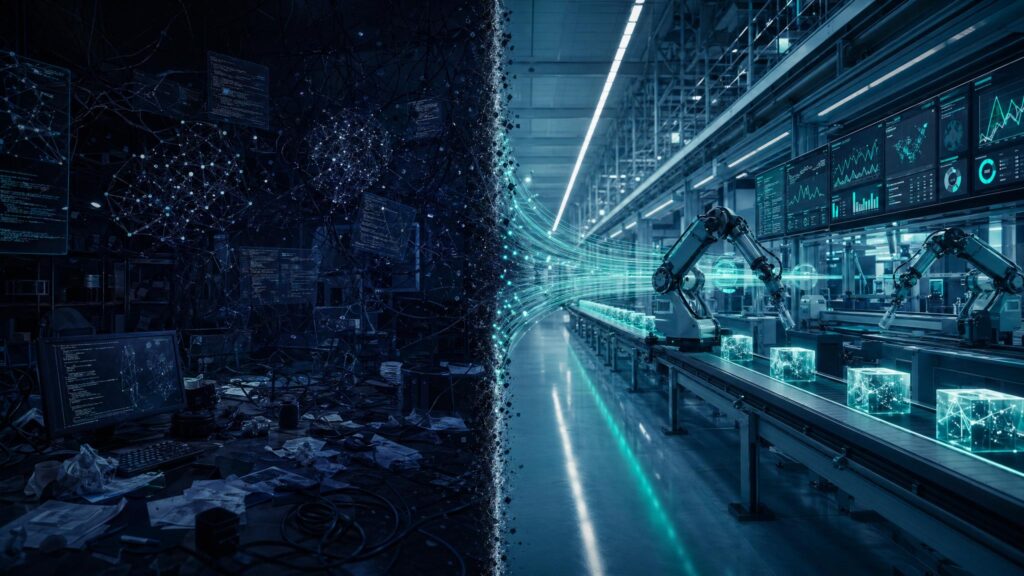
There’s a figure that should make every AI investment pause for a moment: 87% of all machine learning models never reach production. They get stuck in the lab, in a pilot that drags on, or in an environment where no one really knows who will take over when a data scientist is done. Meanwhile, the Machine Learning Operations (MLOps) market is growing rapidly and is expected to pass $21 billion in 2026.
The gap between what is invested and what is actually run live is almost never about bad algorithms. It’s about the infrastructure and processes around the model not working together.
At Aixia, we see this as the biggest challenge for Swedish companies right now. The question is no longer who builds the smartest model, but who can keep it alive when faced with real data, real users and real operational requirements.
MLOps is not an option – it is the engine
What fails in most projects is not the training. It’s everything that comes after. When the model goes into production, questions arise that no one has really owned: How do we know it will still be performing in three months? Who sounds the alarm when the data flow changes? How do we roll out a new version without stopping operations?
It is the answers to these questions that are driving the MLOps market. Automated monitoring, versioning and deployment tools are no longer ‘add-ons’. They are the prerequisite for a model to last more than one quarter in operation.
Without a management plan, each pilot becomes a future technical liability.
Where AiQu comes in
We built our AiQu platform to solve exactly this. It’s not enough to deliver fast computing power if the customer is then left alone with deployment, monitoring and updates.
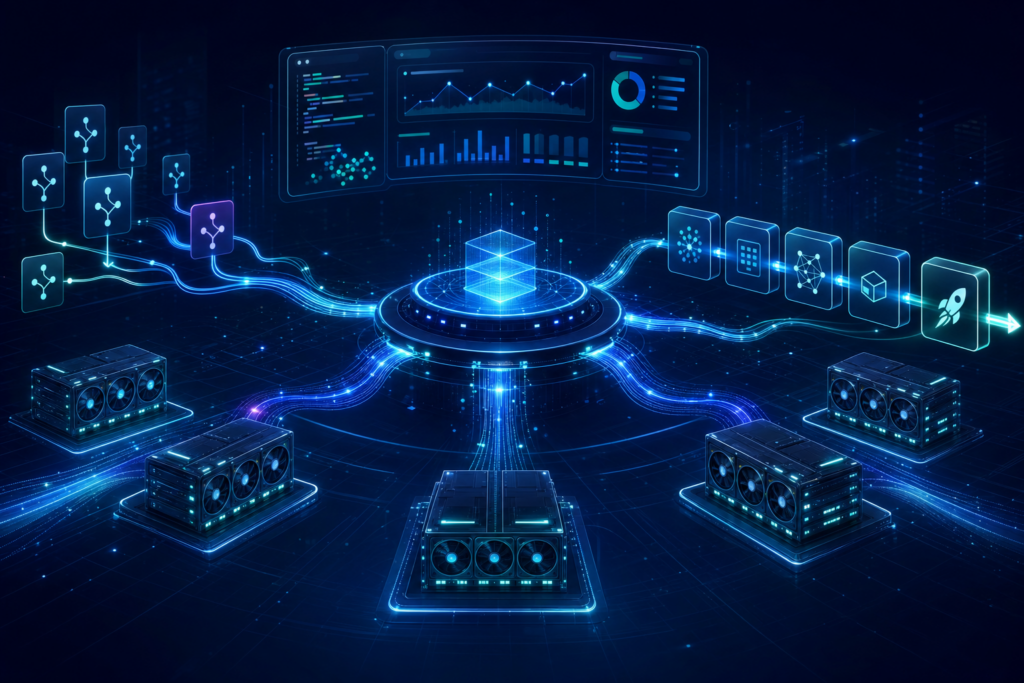
AiQu connects the hardware with the operational tools needed to actually run models in production – orchestration, monitoring and control in one place. This means that you can scale up the use without scaling up the organization at the same rate. Something that is crucial for most Swedish companies, where there are simply not enough ML engineers to recruit.
Our position: the whole chain, not just parts
Most vendors are sitting on a piece of the problem. Either they sell MLOps software without understanding what happens at the GPU level, or they sell hardware without caring what the customer will do with it.
We do both. That’s where the value comes from – when the infrastructure and operations are designed for each other from the start. For a Swedish industrial company, this means not having to integrate five suppliers and hope for the best. We take responsibility for ensuring that the entire path from data to production works.
What we recommend
If you recognize the picture – that pilots are lying around and nothing really reaches the business – then our advice is to change focus. Spend less time finding the next use case and more time understanding why the ones you already have are not reaching production. That’s where the value is right now.
A functioning MLOps foundation determines whether your AI becomes a strategic asset or an expensive hobby. We’ve been through this with several Swedish companies and know where it usually goes wrong.
Do you want to have a discussion?
- 📞 Phone: +46 (0) 31 762 02 40
- ✉️ E-mail: info@aixia.se
- 🌐 Web: Read more about AiQu
Aixia AB is a leading provider of AI infrastructure and MLOps solutions in the Nordic region. With the AiQu platform, we help companies industrialize their AI operations.