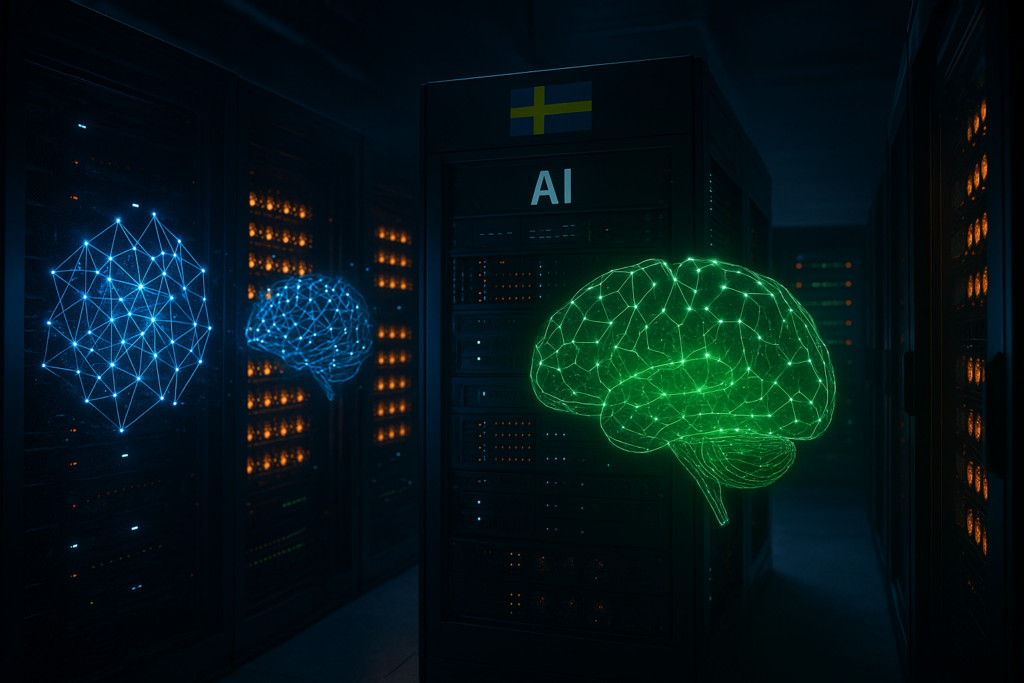
We are currently in what can be described as the intense school of the AI revolution. In recent years, almost all the focus has been on the enormous computational power required to train the models we see today, a process in which unimaginable amounts of data are chewed through to build cognitive understanding. But according to recent insights from the JLL Global Data Center Outlook 2026, we are now approaching a fundamental turning point. By 2027, AI workloads are predicted to shift dramatically from being one-quarter training to being dominated by inference, which is the phase where the model is actually used to make decisions in a real-world environment.
To understand what this means for the IT strategy of the future, we need to disentangle the difference between these two worlds. Training is the infancy of the model; it is a resource-intensive period that often takes place in massive, centralized data centers where the focus is on high throughput rather than speed of each individual response. Inference, on the other hand, is AI at work. It’s the moment when a self-driving car identifies an obstacle or when a medical device analyzes a tissue during surgery. In these situations, throughput is secondary and latency – the time it takes from question to answer – the only currency that actually matters.
This shift places entirely new demands on the underlying infrastructure, demands for which we at Aixia have been preparing for a long time. As the emphasis shifts to real-time decisions, it is no longer enough to send data to a cloud at the other end of Europe. If an autonomous system on a Swedish factory floor requires a decision, a delay of a hundred milliseconds for a round-trip to a public data center is a minor eternity. Inference requires proximity and a distributed architecture that delivers computational power at the edge of the network, right where events happen.
Swedish companies in heavy sectors such as automotive, defense and medtech are already at the forefront of this development. They realize that an AI model that thinks too slowly in a critical situation quickly turns from an asset to a risk. By using local, ultra-low latency infrastructure on Swedish soil, these pioneers can ensure that their applications are not only intelligent in theory, but also responsive in practice. It’s about building a sovereign environment where you own both the decision and the speed at which it is made.
By 2027, every forward-looking management team needs to rethink its AI strategy. It’s no longer enough to ask how to build the smartest model; you need to ask where decision-making will take place and what the latency budget looks like for the business’s most important processes. If the infrastructure is not dimensioned for the coming wave of inference, you risk ending up with a powerful digital brain that lacks the ability to communicate with the outside world at the required pace. At Aixia, we have already built the foundation for your models to think, act and deliver value the second the need arises.
Is your IT environment ready for the shift from lab to real-time operation? At Aixia, we help you future-proof your infrastructure for the 2027 requirements for local inference and extremely low latency.