It almost always starts the same way. The company tests an AI project in the cloud, sees promising results, and decides to scale. Then the invoice arrives. Suddenly, we’re no longer talking about an experimental budget – we’re talking about an ongoing operational cost that no one really calculated.
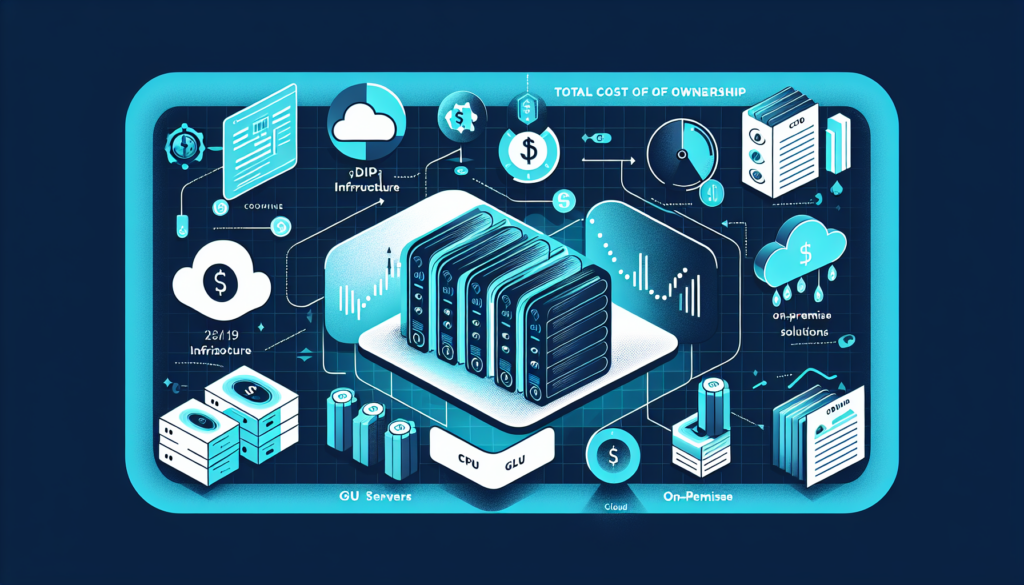
TCO – Total Cost of Ownership – is a well-known concept in the IT world. But for AI infrastructure, it is more complex and more often miscalculated than for almost any other technology investment. This is because the costs are invisible in different places depending on whether you are running in the cloud, on-prem, or a hybrid solution.
This is our briefing. Not to scare anyone, but to provide a factual basis for making the right decisions.
Why the cloud calculus cracks when scaling
Cloud providers are good at offering low threshold costs. It’s easy to get started, and the first thousand dollars in GPU time feels manageable. The problem arises when you go from training a model to running it continuously in production.
An H100 instance in the hyperscaler cloud costs about $25-35 per hour. That sounds reasonable – until you consider that a production model may need to run 24/7. That quickly adds up to $200,000-250,000 per month, per GPU. And most serious AI environments need more than one.
In addition, there are egress costs (moving data out of the cloud), storage costs that scale with the amount of data, and licensing costs for platform tools that are often hidden in the initial evaluations. Costs that are difficult to see in a pilot phase, but are clearly visible in the quarterly report.
On-prem underestimates operating cost
Own servers and GPU clusters naturally have a different cost profile. The investment is larger initially, but the marginal cost per GPU hour is significantly lower once the hardware is paid for. That’s the simple argument for on-prem – and it’s true, but it’s not the whole picture.
What is underestimated is the operational cost. Maintaining a GPU cluster requires skills that are not cheap. Cooling, power, network infrastructure, updates, troubleshooting – these are all real costs that are rarely included in the initial calculation. And if you don’t have a dedicated team for it, on-prem can quickly cost more in time and frustration than the cloud costs in dollars.
This is where a managed platform like AiQu changes the calculus. You get on-prem control and cost-efficiency when scaling, but without building the entire operations organization yourself.
The three costs that are almost always missed
Whether you’re running in the cloud or on-prem, there are three costs that are consistently underestimated in AI-TCO calculations:
Data management and preparation. Up to 80% of the working time in an AI project is spent preparing data, not building models. If the infrastructure handling the data is expensive, fragmented, or requires manual labor, that’s a direct cost that rarely shows up in a GPU calculation.
MLOps overhead. Each new model needs to be versioned, tested, deployed and monitored. Without a standardized MLOps layer, each team does it in its own way, multiplying the work time. It’s an organizational cost, but it’s as real as a billing cycle.
Lock-in and migration. If you build your pipelines deeply integrated with a specific cloud provider, the switch later on is expensive – not only technically, but also in man-hours and potentially in downtime. It is a cost that is not visible at all in year one.
What a reasonable TCO calculation looks like
A well thought out TCO for AI infrastructure should include:
– Hardware or cloud cost
– Energy and cooling (for on-prem)
– Operational staff or managed service cost
– MLOps platform and tools
– Data storage and operational costs
– The cost of not being in control – i.e. the risk of vendor lock-in, compliance issues and unforeseen migrations
It’s not an easy calculation. But it’s a necessary one – especially as AI begins to take its place as a business-critical function rather than a side project.
What we see in customers
At Aixia, we’ve been helping organizations do just this analysis for the past few years. The picture is fairly consistent: those who do the proper TCO math almost always choose a hybrid model – in-house resources for core workloads, with flexible capacity when needed – and a platform that makes the cost of operation predictable.
That is not an argument against the cloud. It’s an argument for counting on it properly.
If you want to review your own situation, we are happy to be part of that conversation. Contact us at Aixia or start exploring AiQu at aiqu.ai.