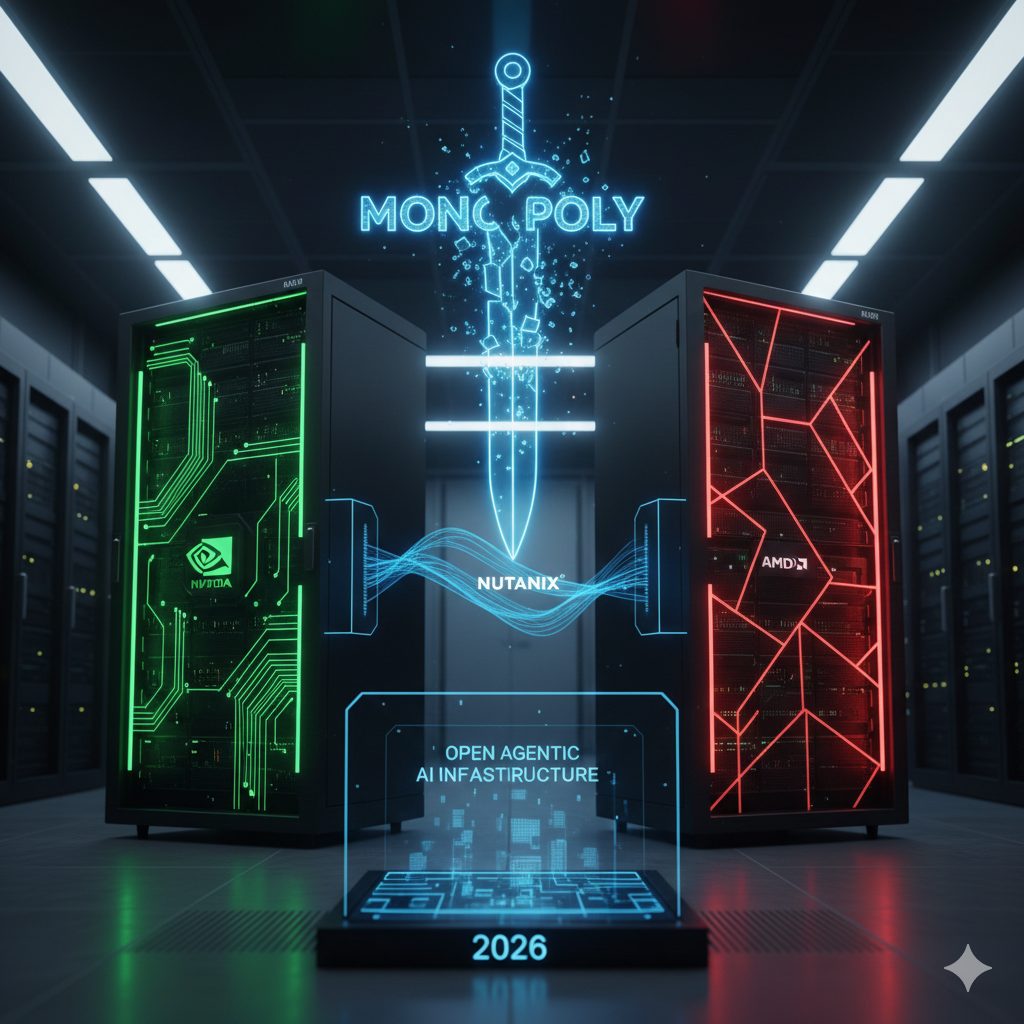
In recent years, AI infrastructure has basically been synonymous with a single provider. But in recent days, we’ve seen a shift that could redraw the map for Swedish AI operations going forward. The collaboration between AMD and Nutanix on an open, agentic AI infrastructure is more than just a technical partnership – it’s a sign that the enterprise AI market is finally starting to mature. For us at Aixia, who help companies move from pilot to full-scale production every day, this is a welcome development. The decisions you make in 2026 will lock your architecture for a long time to come. Having alternatives to the current dominance is not only good for your wallet, it is crucial for your strategic freedom.
Why is this relevant now?
We see that the focus quickly shifts from just training models to actually running them in production (inference). This is where the costs and complexity tend to go up. With AMD now stepping forward with its MI300X accelerators and Nutanix contributing its software platform, it’s all about lowering the thresholds.
Here are the three key insights from this collaboration:
1. openness vs. lockdown
Many companies are stuck in proprietary ecosystems. By investing in open source and standardized infrastructure, organizations can build AI capabilities without becoming hostage to a single hardware vendor.
2. Optimization for “Agentic AI”
The AI of the future is not just about chatbots answering questions. We’re talking about agents that perform tasks autonomously. That requires a completely different kind of stability and scalability in the infrastructure than a simple demo does.
3. Total economy in production
When scaling up AI operations, the price per computation (inference economics) becomes the single most important factor. Competition on the hardware side is the fastest route to better margins in your AI venture.
Sovereignty and freedom of choice
This is very much in line with what we at Aixia talk about when we discuss Sovereign AI. Sovereignty is not only about where the data is stored, but also about having power over your own tech stack. Being able to run powerful models on different types of hardware is a key component of a resilient IT strategy.
Through our AiQu platform, we have already created an environment where you can manage your AI workloads independently of underlying resources. The fact that AMD and Nutanix are now choosing the open path confirms that our vision of a flexible and controlled AI infrastructure is the right way forward.
What does this mean for you?
Are you going to run out and replace all your existing hardware tomorrow? No, probably not. But you should definitely evaluate whether your next expansion should be in a closed or open ecosystem. The choices you make today will determine how agile you are in 2027 and beyond.
It’s about building an environment that is ready for the autonomous agents of the future, without losing control of costs.
Are you curious?
Curious about how AMD and Nutanix’s new venture fits into your specific roadmap? We at Aixia are happy to help you navigate the new landscape and ensure that you build an AI infrastructure that lasts over time.
Get in touch and we’ll have an informal chat about your production plans.